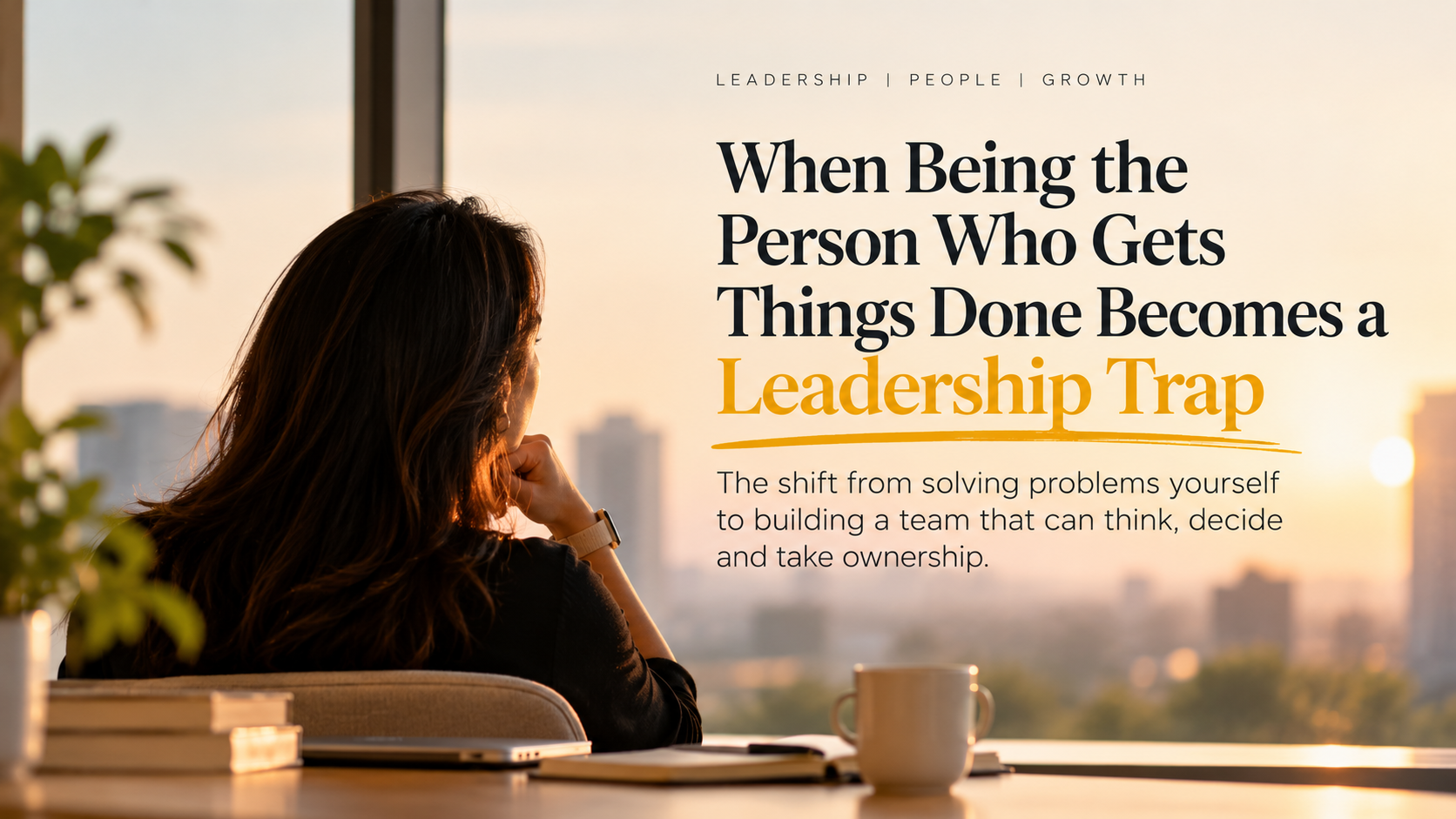
When Being the Person Who Gets Things Done Becomes a Leadership Trap
For a large part of my career, being dependable meant being the person who could get things done.
When something needed to be solved, I took ownership. When a decision had to be made, I stepped in. When things got stuck, I found a way to move them forward.
I was comfortable being the person people could rely on — the one who knew what to do, found the answers and made things happen.
And for a long time, that worked.
Taking ownership, solving problems and being dependable had helped me build my career. These were strengths I valued in myself, and qualities others came to rely on.
But leadership introduced a different kind of responsibility.
I was no longer accountable only for what I could deliver myself. I was also responsible for creating an environment in which other people could deliver, develop and make decisions.
I understood that intellectually. What took longer was recognising how much my own habits would need to change.
When Helping Becomes the Default
When I moved into management, I carried many of the habits that had helped me succeed as an individual contributor.
I was used to taking ownership, finding solutions and making things happen. When something needed to be done, I could usually work out how to get it done. And when someone needed help, my instinct was to step in.
So when someone from my team came to me with a problem, I would often have an answer in mind before they had finished explaining it.
I understood the context. I had probably encountered something similar before. And I could often see a way forward.
So I would tell them what I thought they should do.
The problem got solved. The work moved forward. I had been helpful.
But then another question would come. Another decision would need my input. Another situation would be escalated to me.
And gradually, I began noticing a pattern.
People were coming to me for answers, sometimes before they had fully worked through the problem themselves.
I remember wondering:
Why does everything keep coming back to me?
Initially, it was easy to interpret this as a sign of trust. My team knew I would help. They knew I could unblock things. And I wanted to be the kind of manager who was accessible and supportive.
But I also had to consider another possibility.
Had I become the fastest route to an answer?
By stepping in quickly, was I unintentionally making it easier for people to rely on my judgement than to develop their own?
I wasn’t deliberately trying to control every decision. I was trying to help, just as I always had.
But I was now in a different role, with a different responsibility.
As an individual contributor, solving the problem myself often helped me deliver better and faster. As a manager, repeatedly solving the problem for someone else could mean that the same person returned with a similar problem the next time.
The immediate issue was resolved, but the underlying capability hadn’t necessarily developed.
That was an uncomfortable realisation because the behaviour wasn’t coming from a lack of commitment. It was coming from a strength I had relied on for years.
And I began to understand that what makes you effective at getting work done doesn’t automatically make you effective at helping others do it.
The Hidden Cost of Being a High Performer
I now recognise this pattern in my coaching conversations with first-time managers, too.
Many are capable, committed professionals who have built their reputations by taking ownership, solving problems and delivering results. They care about the quality of their work and don’t want things to fall through the cracks.
When they move into leadership, they carry those same instincts into a role that asks something different of them.
They delegate a task, but continue checking every step.
They ask someone to take responsibility, but step in when the approach differs from their own.
They want their team to be more independent, but find it difficult to let a decision unfold without their involvement.
And the more experienced or capable the manager is, the easier it can be to justify stepping in.
“I can do this faster.”
“It will take longer to explain.”
“What if it doesn’t get done properly?”
These concerns are understandable. Sometimes, stepping in is exactly what the situation requires. But when it becomes the default response, it can leave very little room for others to develop their own judgement.
Research offers some perspective on how common this challenge can be.
A 2017 Impellus survey of 674 managers found that 40% said they were scared to let go and delegate tasks when they were first appointed to management.
DDI (Development Dimensions International), in assessments of more than 70,000 manager candidates, found that only 19% demonstrated strong delegation skills.
These findings highlight the challenge many managers face when transitioning from being the person who gets things done to the person responsible for enabling others to deliver.
For many high performers, letting go means changing a familiar relationship with their own value.
For years, being good at your job may have meant knowing the answer, solving the problem and being someone others could depend on. You were recognised for your expertise and your ability to deliver.
Then leadership asks you to do something less familiar: allow someone else to work through a problem, make a decision and learn from the experience, even when you can see a faster route yourself.
That can feel uncomfortable.
You may worry about the quality of the outcome, the time it will take or the possibility that someone will make a mistake. You may also find that being the person with the answers is a role you are reluctant to give up.
I have had to reflect on this in my own leadership journey, and I see similar tensions in the leaders I coach.
The challenge isn’t necessarily that we don’t understand the importance of developing our teams. It is that, in the moment, our instinct to solve can be stronger than our intention to develop.
And that is where we need to become more deliberate.
Because if we keep solving the same problems for our teams, we may keep getting the immediate results we want while missing opportunities to build the capability we need.
The question isn’t whether you can solve the problem. It’s whether solving it yourself is always the most valuable contribution you can make.
The Shift Wasn’t to Stop Helping. It Was to Help Differently.
For me, the change began with a question.
Instead of asking, “How do I get this off my plate?” I started thinking about, “What can this person own?”
It sounds like a small difference, but it changes where your attention goes.
The first question focuses on the task and the time it will take. The second asks you to consider the person, their capability and the decisions they could learn to make.
It doesn’t mean stepping away and leaving someone to figure everything out alone.
People still need context. They need clarity about the outcome, an understanding of what good looks like and support when the situation calls for it.
But they also need room to think.
So, instead of immediately offering a solution, I began paying more attention to the questions I could ask.
“What have you considered so far?”
“What options do you see?”
“What would you recommend, and why?”
“What do you need from me to move forward?”
These questions don’t replace direction or expertise. There are situations where a clear answer is necessary, where the stakes are high or where a decision needs to be made quickly.
The point is not to turn every interaction into a coaching conversation.
It is to recognise when giving the answer is the right response — and when helping someone develop their own answer would be more valuable.
That distinction is where I believe leadership begins to change.
The Result Is Bigger Than Having More Time
When a manager stops being the automatic answer to every question, the benefits go beyond a lighter workload.
The conversations can begin to change.
Instead of hearing, “I have a problem. What should I do?”, you start hearing, “Here are the options I’ve considered. I recommend this one because…”
The person is no longer simply bringing you a problem. They’re bringing you their thinking.
That is a different level of ownership.
It creates opportunities for people to practise judgement, make decisions and become more confident in their ability to handle challenges. It also gives the manager more space to focus on the work that genuinely requires their attention.
Of course, this doesn’t happen overnight. It takes consistency, clarity and a willingness to let people learn. Sometimes they will take longer than you would. Sometimes they will choose a different approach. Sometimes you will still need to step in.
The shift is not about getting everything right the first time.
It is about being intentional about what happens the next time.
I continue to reflect on this in my own leadership journey and in the work I do with leaders. It is easy to measure our contribution by how many problems we solve, how quickly we respond and how often people turn to us.
A more difficult question is whether our involvement is helping other people become more capable — or simply making us indispensable.
A Question Worth Sitting With
If you are a first-time manager, or someone preparing to step into leadership, think about the problems that keep finding their way back to you.
Is this something only you can do?
Or are you holding on because you can do it faster, because you know the answer, or because it feels safer to stay involved?
And perhaps the most important question:
If I keep doing this for my team, what capability might I be preventing someone else from developing?
You don’t have to change everything at once. Start with one recurring decision, one conversation or one task that could become an opportunity for someone else to take greater ownership.
Your experience still matters. Your expertise still matters. Your ability to step in when needed still matters.
But leadership asks you to use those strengths differently.
You move from being the person who creates every result to creating the conditions in which other people can create results, too.
For me, that remains one of the most important shifts in moving from being a high performer to becoming a leader.
Your job isn’t to become less useful. It’s to use your usefulness differently.
And perhaps the real measure of your leadership isn’t how often your team needs you to have the answer — but how well they learn to think, decide and move forward when the answer is theirs to find.